
7 Surprising Facts About Comics: Your Guide to Escaping Boredom!

Comics have their very own holiday each year: International Comic Book Day is observed on 25 September. The charming cartoon stories featuring characters that talk in typical “bubbles” are not a new concept. Thus, at Where to Get Bored, we kick off our journey into the world of comics by looking back into history: the origins of those vibrant cartoon tales about the Four Leaf CloverGarfield, Batman, Muriel, Donald Duck, Pifo, Quick Arrows, the Mourrisons, and other beloved superheroes can be traced back to Trajan’s Column in Rome, found in Egyptian hieroglyphics, or depicted in the Bayeux Tapestry.
1. Historical comics on the screen and on the walls
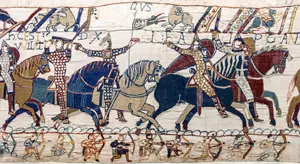 If you’re thinking of visiting France, you can see this amazing work of art in Bayeux: over half a meter wide and almost seventy meters long, this embroidered fabric acts like an ancient comic strip, narrating the events leading up to the Norman invasion of England in 1066, along with the invasion itself. According to French legend, Queen Mathilde, the wife of William the Conqueror, and her ladies-in-waiting created it, although the earliest written mention of this treasure dates back to 1476. A more contemporary piece is a tapestry crafted by textile artist and art history teacher Věra Mičková from Olomouc, whose work travels to various exhibitions around the globe.
The art of comics can also be seen in the detailed murals found in the walls of certain castles. For example, a tour at Jindřichův Hradec Castle and Chateau takes visitors inside a medieval palace where a gothic mural depicts the legend of St. George. While Bayeux Tapestry includes explanatory Latin inscriptions, these wall bubbles are noticeably absent.
2. Jinotaje and comics for adults
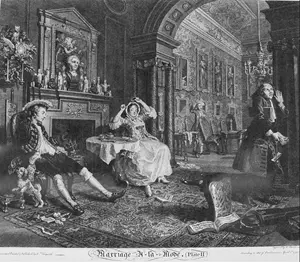 The idea that comics aren’t just for kids is backed by a series of artworks by William Hogarth (1697-1764), an English painter and engraver. He played a crucial role in developing satire and caricature, and through this lens, he created several series of sequential images critiquing various aspects of the political and social life of the 17th and 18th centuries. Hogarth became well-known for his engravings, including The Progress of the Harlot, followed by The Count’s Progress and Marriage à-la-Mode. These served as pictorial narratives and moral warnings full of subtle meanings, becoming popular and earning Hogarth lasting fame.
3. Yellow Child and Quick Arrows
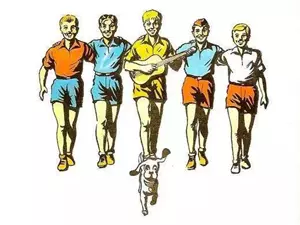 When did modern comics first appear? According to American history, it was on February 16, 1896, when Richard Outcault debuted the Yellow Kid comic in the New York World magazine. Czech comics came a bit later, emerging in the 1920s. Among the most recognized are the comics by Josef Lada, featuring animal heroes aimed at younger audiences, and Ondřej Sekora’s tales like Ferd Mravenec, Chicken Napipi, Captain Animuk , and dog Rek. The true phenomenon of Czech comics is the celebrated Rychlé šípy and the adventures of Mirek Dušín, Jarka Metelka, Jindra Hojer, Červenáček, and Rychlonožka. Their creator was Jaroslav Foglar (1907-1999), and it was later illustrated by Jan Fischer, Václav Junek, Bohumír Čermák, and Marko Čermák.
4. The Cloverleaf Phenomenon
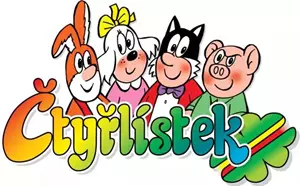 In 1969, the kid’s comic strip The Four Leaf Clover was launched. The tales of Myšpulín, Bobík, Pindi, and Fifinka continue to be published today, created and illustrated by Jaroslav Němeček (*1944). Other series have also graced the magazine, such as Cop and Olda by Jaroslav Malák, Mr. Semtamtchuk’s inventions by Adolf Born, and Anča and Pepík by Lucie Lomová. The four-leaf clover proudly claims its spot in the Czech Book of Records as the longest-running Czech comic, boasting almost a thousand issues. Additionally, Čtyřlístek has its own website, postage stamps, a Museum of Čtyřlístek in Doksy, and even a fairy tale trail called With Čtyřlístek around Blat’ák.
5. From Green Raoul to Mourrison
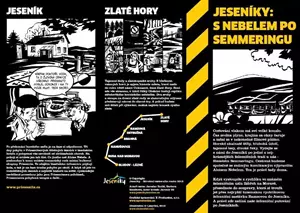 Among the more contemporary adult comics is the original Czech Green Raoul comic. With the full title Zelený Raoul or The Endless Story of the Czech Republic through the Eyes of a Ufone, it was in circulation from 1995 to 2022 in Reflex weekly. The comic illustrations were done by Štěpán Mareš, while scripts came from the hands of three editors of Reflex—Dan Hrubý, Milan Tesar , and Tomas Baldynsky. Also noteworthy is Jaroslav Rudiš’s comic Alois Nebel, which was not only published as a comic book but also adapted into a film, along with The Great Journey of Vlas and Brady by the well-known artist František Skála. Comic strips, which began appearing in children’s magazines during the 1970s, also became an undeniable phenomenon. Publications such as Ohníček, Mateřídouška, Sedmička, and featured on the last page of ABC magazine have enjoyed popularity since 2002. Mourrison, the feline hero without a poem or a henna is created by Lukas Fibrich.
6. The best Czech comics
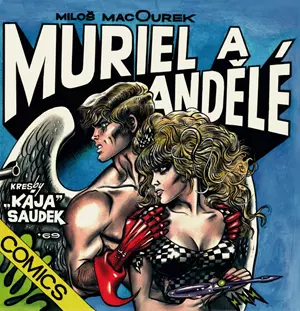 In 2009, the website Komiksárium conducted a poll to find the best Czech comic of all time. The winner, chosen as the best Czech comic in history, was Kája Saudek’s Muriel and the Angels. The jury praised it as “an excellent blend of adventure, romance, and humor.” The creators of this beloved story were Kája Saudek and Miloš Macourek, with several characters inspired by real people from the artist’s life. For example, the character Muriel was based on Saudek’s then-girlfriend, actress Olga Schober, and the main antagonist, General Xeron, was inspired by his brother Jan Saudek.
Additionally, the brilliant cartoonist Saudek took third place with the equally renowned Lips Tullian series. This tale of “the most feared robber chief” is set during the mid-17th century in Bohemia and German Saxony and is inspired by a real character who served Friedrich Schiller as a model for his famous work, Robbers (1781). Jaroslav Weigel illustrated the comic, which appeared in the 1970s as a series in Young World magazine.
Recent successful Czech comics include a comic about Miroslav Zikmund titled “Talent and Creativity for Life,” showcased as part of the Czech Republic’s participation in EXPO 2025. Awards recognized the comic at the Murie Awards, and in 2025 it won for “Winton was not alone.”
7. Pullitzer Prize for Comics
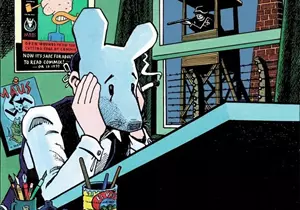 Pulitzer Prize is a prestigious annual award in American journalism and arts. This significant award was established by a Hungarian-American journalist named Joseph Pulitzer and has been presented since 1917. One prominent recipient is Art Spiegelman, an American comic book artist, editor, and writer. He was born in Sweden to Jewish refugees Vladek and Anja Spiegelman, who endured Auschwitz and Dachau concentration camps. In 1960, the family relocated to the USA, and young Spiegelman discovered comic storytelling, which inspired him to begin creating his own. His impactful graphic novel Maus is a deeply moving representation of the Holocaust, delivered in a comic strip format. In this story, Jews are depicted as mice, Germans as cats, and Poles as pigs. In 1992, Maus made history as the first comic to be awarded the Pulitzer Prize.


