
Prague’s Secrets and Legends: An A–Z of the City’s Hidden Faces

Every city has its faces, and Prague has so many that you would need to take time off to meet them all. So we decided to explore Prague’s secrets and legends in alphabetical order, as if we were compiling a dictionary of the big city’s soul – from alchemy to railways, and from brothels to Baroque. Don’t expect a standard guide. What interests us is not the streets but the layers beneath them, the ones that only show themselves now and then – at night, in the fog or in a passing hint.
A for Alchemical, Astrological and Astronomical
 Prague, a city rich in mystery and a thirst for knowledge, has let itself be ruled by the stars and alchemical dreams since the Middle Ages. Things came to the boil under Rudolf II, when magicians, charlatans and geniuses walked its streets, palaces and cellars. Among them were John Dee and Edward Kelley, who searched for the elixir of immortality, the imperial astrologer Tycho Brahe and Johannes Kepler. Their ideas left a mark not only on science but on the city itself – for instance on the famous Old Town astronomical clock, the only one in the world that measures Babylonian time.
Astrology, astronomy, alchemy – in Prague they have always been so intertwined that it is hard to tell them apart. The city itself seems like a magical body in which the planets never quite stand still. If you want to get to the bottom of it, head to the observatory or the planetarium. Perhaps that is where you will find your own magical constellation, elixir of youth or philosopher’s stone.
B for Baroque
 Say Baroque and many people picture gold, saints in dramatic poses and cherubs on the cornices. But Prague Baroque isn’t just a style – it is a concept. Excess, sweep, movement, the silence just before an organ chord. Just look up: domes, bell towers, spires, columns and statues all point to the sky. Baroque Prague is a city in motion. Nothing here stands straight; everything leans, twists and clasps its hands towards heaven. And yet it all holds together. Perhaps because Prague is Baroque not only in its facades but in its soul – deep, exaggerated, theatrical, and beautiful precisely because of it.
Baroque did not settle in Prague quietly. On the contrary, it spread out lavishly, from Malostranské náměstí all the way to Vyšehrad. In the Church of St Nicholas in the Lesser Town you will be overwhelmed by monumental music and the scent of wax. And on Charles Bridge, St John of Nepomuk still glances over his shoulder, as if he knew that he is one of the main faces of Prague Baroque.
Want to experience it for yourself? Visit the Loreto, walk past the Clam-Gallas Palace or go to a Baroque music concert in the Church of St James. You will soon understand why Baroque has never quite left Prague and still feels at home here today.
C for Cimrman, Cosmopolitan and Confectionery
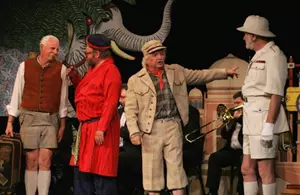 Cimrman’s Prague is the kind of place that knows how to make fun of itself – and does it with such grace that you are not sure whether you are laughing at it or admiring it. Welcome to a city where the fictional Czech genius Jára Cimrman was not born, yet he has a theatre and a mud spa here and may one day even get a metro station. Cimrman’s Prague is full of mistakes, dead ends and lovely misunderstandings, and that is exactly what makes it so true.
Cosmopolitan Prague smells of Vietnamese pho, sounds of Ukrainian and mixes Arabic coffee with Indian curry. Its pavements are layered with languages and scents – from the Jewish Quarter to the Vietnamese corner shops on the outskirts. Touristy? Perhaps. But underneath is a city that has always been a crossroads of languages, religions, cuisines and stories.
And confectionery Prague? It smells sweet from early morning. From the Art Nouveau Café Slavia and the legendary Ovocný Světozor to the elegant patisseries of Vinohrady, where cakes look like architectural models. This is Prague on a plate – a little nostalgic, a little snobbish, but always delicious.
D for Děsivá (Scary)
 Prague has its charms – and then it has its shadows. Old cemeteries, execution sites, the legends of Vyšehrad, the Golem, said to be still sleeping in the attic of the Old-New Synagogue, and Faust’s House, where traces of the devil are said to remain even after centuries. Beneath it all lies a tangled network of cellars, passages and stories that have never come to light. Scary Prague is not a horror attraction; it is a city that knows how to whisper a reminder that there is no beauty without mystery.
E for Erotic
Prague’s alleys have their dark side, and that side is erotic Prague. In the cabarets and brothels of the Old Town, the oldest profession flourished: prostitutes, bordellos and taverns. This hidden but fascinating side of the city even inspired the TV series Hříšní lidé města pražského (Sinful People of Prague). Only the episode set in the Poison Hut (Jedová chýše) was shot in the studio, because the original shady establishment had disappeared decades earlier.
F for Film
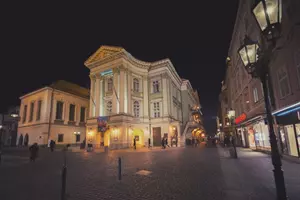 Prague has earned the role of a film star – it has turned into Vienna for Amadeus, Baroque Paris for the series Outlander and the fantasy city of Carnival Row. That series, starring Orlando Bloom and Cara Delevingne, is one of the most expensive productions ever made in the Czech Republic, shot both at Barrandov Studios and on location, for example in Letná, at the Rudolfinum and by the Invalidovna. Prague’s cobbled streets, palaces and corners have served as backdrops for Hollywood crews and home-grown legends alike. In films, Prague is not just scenery; it often plays the lead role.
G for Gastronomic
In Prague you can eat everything – from tasting menus in Michelin-starred restaurants to trdelník with ice cream for a hundred crowns. The city is an edible organism, where the smell of broth from cheap old-style pubs mixes with croissants from Karlín, Vietnamese pho from Holešovice and Žižkov brawn (tlačenka). And then, of course, there is the beer – in some places it has a velvety head, in others it tastes like gutter water. Gastronomic Prague is full of contrasts, but they all have one thing in common: food here is not just a necessity. It’s a ritual, a memory and a reason for another stroll.
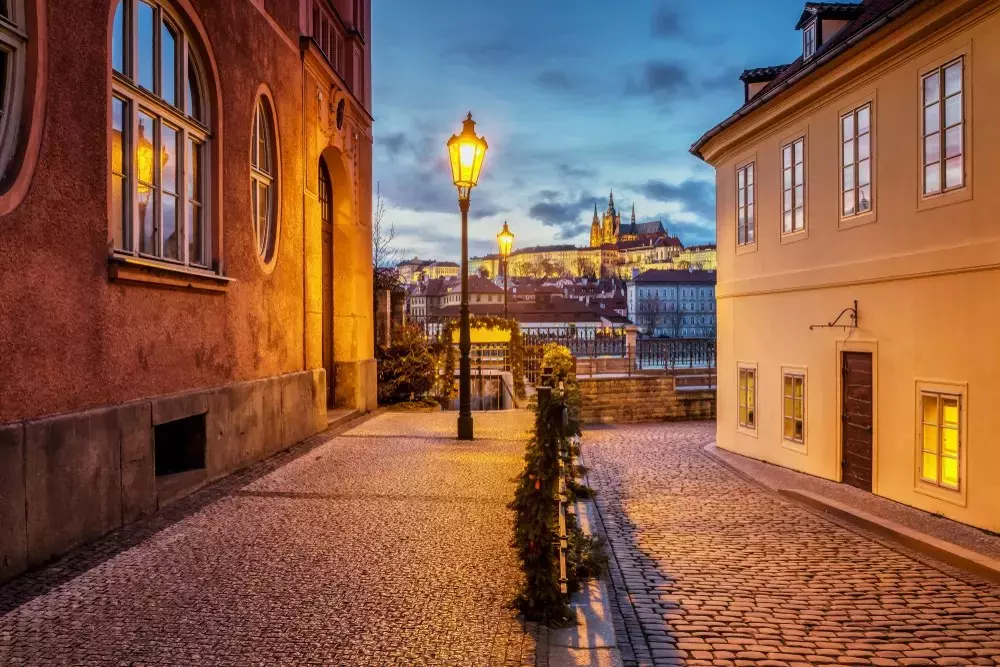
Current food tips and events in Prague
H for Hudební (Musical)
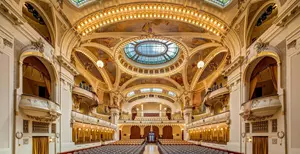 Prague is the city where Mozart conducted Don Giovanni, where Smetana heard Má vlast (My Country) before he wrote it, and where Dvořák had the melodies of the New World Symphony in his head before he left for America. But musical Prague does not live only in the past – it is still playing. In the Municipal House, in cellar jazz clubs and on the street below the astronomical clock. Anyone who wants to go deeper into its history can visit the Czech Museum of Music in a former church. Musical Prague can be both grand and intimate. And sometimes all you need to do is open a window and listen.
CH for Chmurná (Gloomy)
 By day, Prague looks like a beautiful, colourful postcard, but at night it takes on another face. Eerie stories come to life: the gruesome execution in Old Town Square, the gallows on Gallows Hill, skeletons in the cathedral crypts and the stone skull on Charles Bridge. Every shadow has its own story, and some are whispered even in broad daylight. Gloomy Prague is not showy, but it is insistent. It reminds us that beneath every beauty lies something lost, and that even a city can have a soul that knows sorrow.
I for Iconic
You may walk through Prague every day and no longer notice its charms. But according to Lonely Planet, its sights – Charles Bridge, Prague Castle and Old Town Square – are almost too beautiful to be real. Iconic Prague is not just about buildings; it is the feeling of being somewhere you know, even on your first visit. As if the city had come out to meet you. Prague simply has a more famous profile than many a celebrity. Tourists love it, filmmakers use it, locals grumble about it – but they all secretly admire it.
J for Jedinečná and Jazyková (Unique and Linguistic)
Prague is not only the capital of the Czech Republic; it is also a capital of stories. Nowhere else will you find such a close coexistence of Gothic and Brutalism, of German, Czech and Yiddish, of myths and everyday life. It is a city that spoke several languages long before it had properly grown up. From Franz Kafka to Jaroslav Hašek, from German inscriptions on houses to today’s Ukrainian shop signs, linguistic Prague is like a palimpsest: read one layer, and others emerge beneath it. These cultural and linguistic layers make Prague an extraordinary city.
K for Kafkaesque
 Prague is a city where both an official and a soul can get lost, and nobody finds it strange. Kafkaesque Prague is not just the place where Franz Kafka was born. It is a city of anxiety in a beautiful coat, a labyrinth of alleys and forms, where a metaphor or an absurd office counter lurks around every corner. Want to find it? Take a walk through the city in Franz Kafka’s footsteps, visit the Franz Kafka Museum, or simply try to get something done at a government office. Kafkaesque Prague is still very much alive. And there is no escaping it – as Kafka himself knew well.
Where to find culture in Prague?
L for Lennon
 Prague has its sacred places – and one of them came about entirely spontaneously. The Lennon Wall is covered with layers of messages, quotes, drawn hearts and punk poetry. Under socialism people wrote messages about freedom here; today it is a mix of protest, kitsch and selfies. And that is exactly why the place still works. Lennon’s Prague is about the belief that even a wall can speak and that even rebellion can come in the colours of the rainbow. It is a reminder that Prague lived through tanks and a harsh occupation, but also guitars and the Prague Spring of 1968 – and that the word Imagine still has its power.
M for Mystical
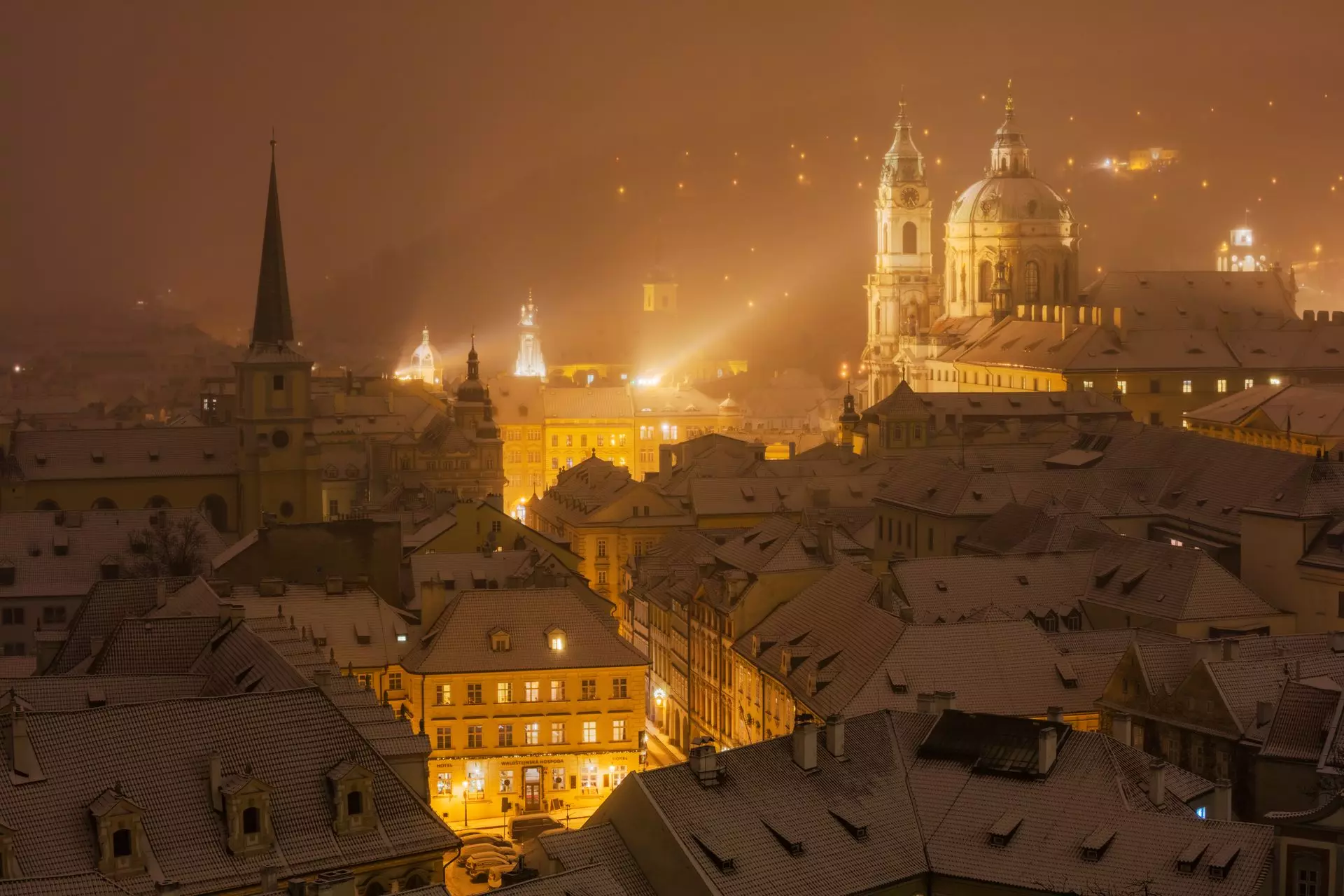
 Some cities are beautiful. Others have atmosphere. But Prague has an aura – something that cannot be described exactly, only sensed. Mystical Prague is the world behind the veil: rune marks on facades, a Templar cross among the house signs, secret Masonic lodges, astrological symbols and the Luxembourg Line. Every one of them hides a secret. Whether you believe in hidden forces or just in the power of stories, mystical Prague will draw you in sooner or later. It is a city where even an ordinary house can have a secret past, and where the fog falls just thick enough to disappear in.
N for Nejkrásnější (Most Beautiful)
Yes, it sounds like a cliché. But it keeps being repeated: Prague is one of the most beautiful cities in the world. In polls by magazines, travel websites and guidebooks it regularly beats Paris, Barcelona and Rome. It dazzles, attracts and takes your breath away. What makes it different? The way it lets itself be admired and ignored at the same time. It will happily show you a grand church with a grubby facade right next to it – and both work together.
Want to find out why Prague appeals to people all over the world? Try finding out for yourself – but be warned, it might change your travel plans.
O for Ospalá (Sleepy)
Prague can be noisy. But when it wants to, it falls so quiet that it almost tingles. A Sunday morning: shop windows still dark, footsteps slowed down, the city staring into its coffee. Everything moves slowly, almost as if Prague were afraid of waking itself up. And that is where its charm lies – drowsy, quiet, without grand gestures.
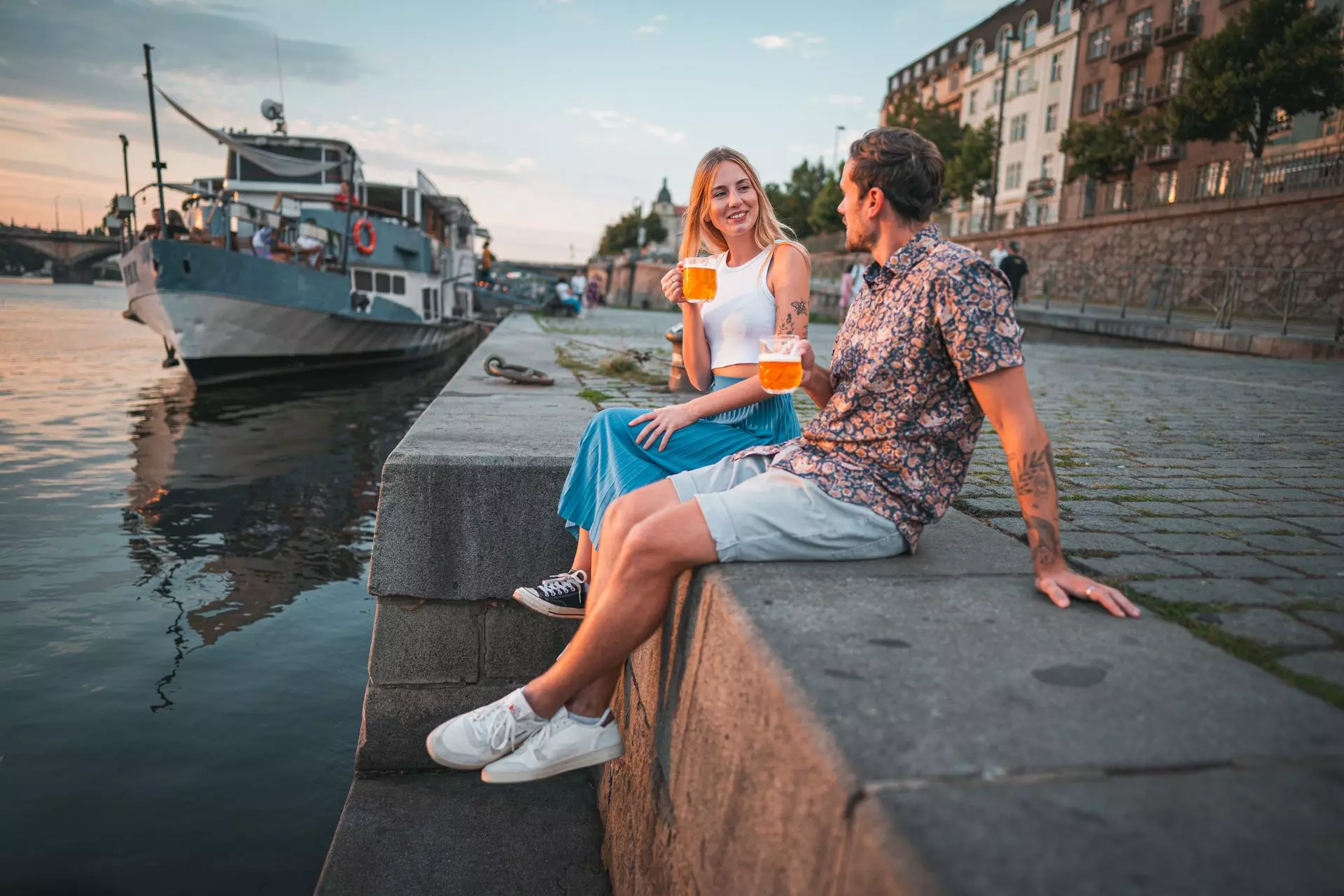
And then comes night. The crowds disappear, the trams sound like an echo of old films, and a sigh escapes from a fifth-floor window. Quiet embankments and riverside walks, a closed burčák stall, jazz from a cellar. A Prague that has not fallen asleep, only breathes more quietly. Sleepy Prague is not lazy; it is simply in a phase where it has nothing to prove. And that may be its most beautiful version.
P for Pivní (Beer)
 In Prague, beer is not just a drink. It is a language, a way of life, a cultural monument and a landmark. “Let’s meet at the bar” can mean anything – a meeting, a therapy session or a cultural event. From the U Fleků brewery, where beer has been poured since 1499, through the Golden Tiger (U Zlatého tygra), where Bohumil Hrabal used to go for a beer, to the Pilsner Urquell experience and new craft breweries whose brewers make IPAs like alchemists in the days of Rudolf II.
Beer Prague is not just about the foam. It is about an atmosphere that cannot be exported or copied. About tables that remember more than the chronicles do. About the moment when the sun sets behind the Castle and your glass mists over. And you really need nothing more.
R for Romantic
 Prague has a special talent for looking like the backdrop to a romantic memory. Whether you are walking hand in hand across Charles Bridge, sitting on a bench on Kampa or lying on a blanket on Petřín Hill or in Riegrovy sady, you feel as if you are in a film you once loved – and perhaps made up yourself. Romantic Prague doesn’t need hearts, love locks or photo spots. Street lamps, cobblestones and the quiet before the rain are enough. A city that lets you be sentimental without anyone judging you. And that is exactly why Prague is so wonderfully romantic.
S for Stověžatá (Hundred-Spired)
Prague has been called the “City of a Hundred Spires” since the 19th century, and although the towers have since been recounted, added and sometimes lost, the name has stuck. It is not about an exact number. It is a feeling, a dream and a kind of beauty. A tower here, a tower there – Prague rises upwards in a rhythm of turrets, bell towers and domes, as if it were always aiming somewhere higher.
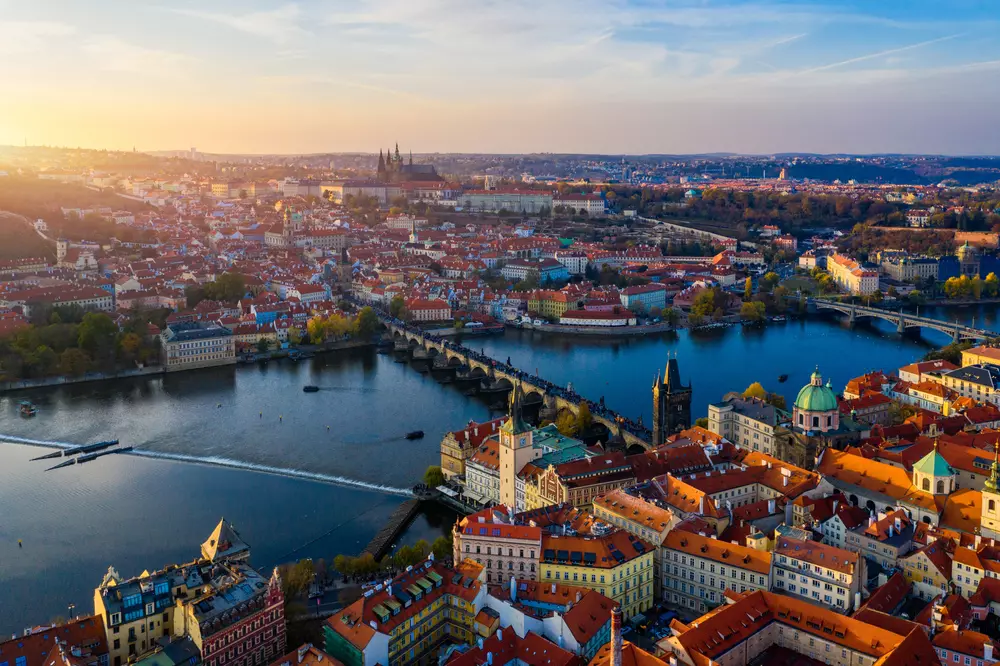
From the viewpoints you see more than a panorama. You see the past rising into the sky. Whether you are standing on Petřín Hill, on the Old Town Hall tower or in the queue for St Vitus Cathedral, you are looking at a city that has never been content with a mere hundred towers.
T for Tram (with a ding)
If you have never ridden the early morning trams, you don’t know Prague. Trams here are not just transport – they are moving viewpoints, time capsules, the city’s pulse. The ding of the bell between the houses, the sharp bends by the National Theatre, the picturesque “mouse hole” by the Clementinum or winter mist on the Vltava embankments towards Výtoň. Tram Prague is a rhythm. It is a way of reading the city – by the window, with headphones on, as life flows past the glass. Whether you are in a retro car with wooden seats or a new air-conditioned tram, the rule still applies: if you don’t know where you’re going, hop on and ride – Prague will take you somewhere.
U for Uměnímilovná (Art-Loving)
Prague doesn’t just exhibit art – it breathes it. In the streets, galleries, theatres and shop windows. From the National Gallery to David Černý’s provocative sculptures, from Alfons Mucha to graffiti in Žižkov. A city where a sculpture can be a joke and where even a tram can become a gallery. Art-loving Prague sometimes plays the snob – but at heart it is a punk with a palette in hand.
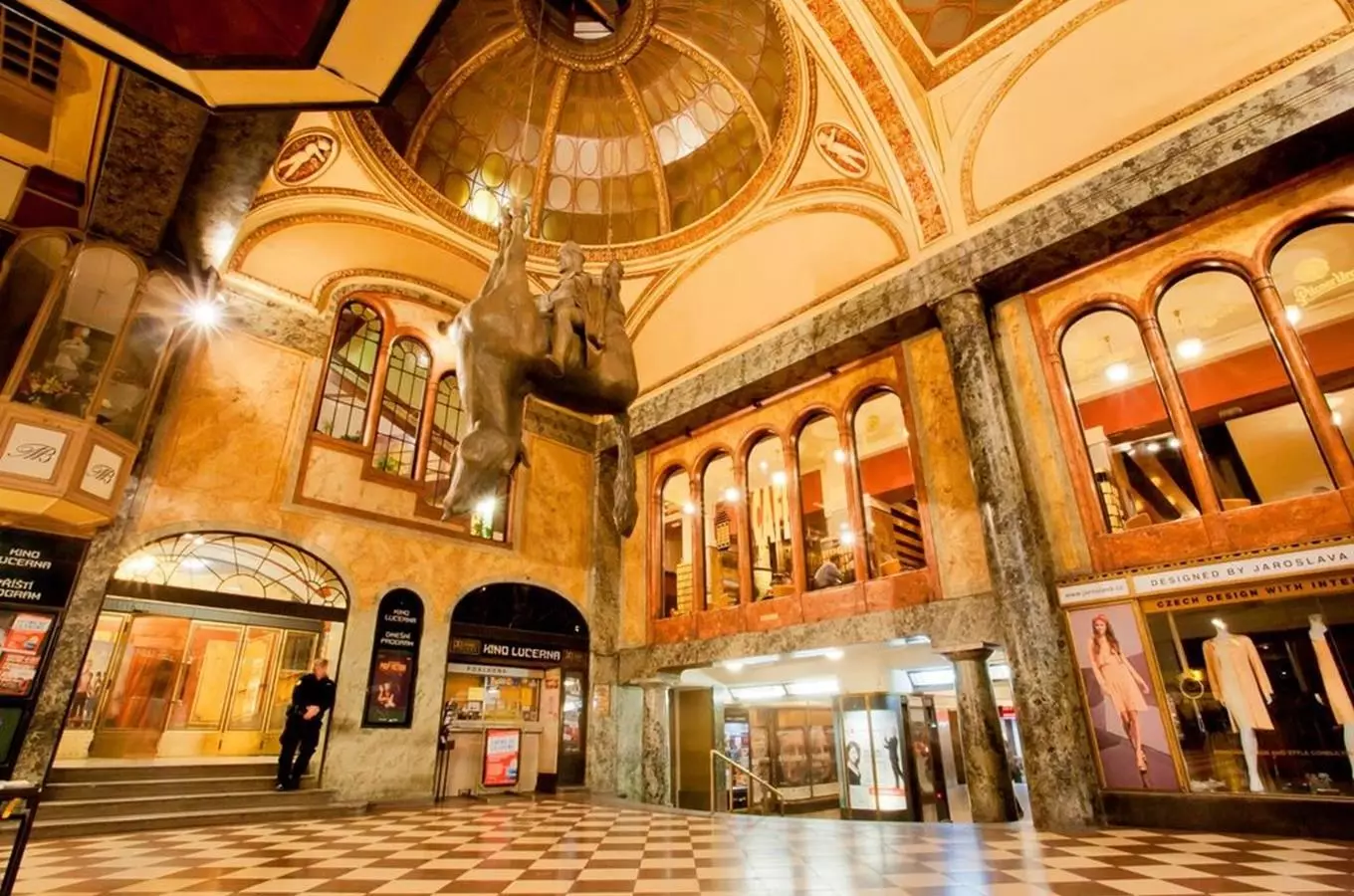
V for Vodnická (Water Goblins)
They are everywhere: under the bridges, on mugs and in legends. Prague may be the only city that takes its vodníci, or water goblins, almost seriously. You will find them on facades, in the names of cafés, in museums and in films. Watch the madcap comedy Jak utopit doktora Mráčka aneb Konec vodníků v Čechách (How to Drown Dr Mráček, or The End of Water Goblins in Bohemia) – one of the films in which Prague plays the lead. And keep your eyes open: Prague’s water goblins are still sitting in their places, dressed in green and smoking their pipes, busily fishing for souls.
Z for Zlatá (Golden)
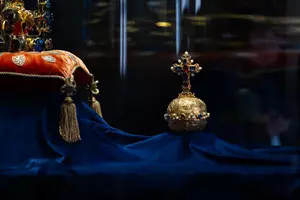 Not only Golden Lane, but also the golden hour for photographers at sunset and the “golden” cobblestones that Praguers complain about but love all the same. Prague is golden because it shines even when it rains. Because its beauty is not polished on the surface but glows from deep inside.
Ž for Železniční (Railway)
 Prague is the only city in the Czech Republic with a metro. A city where the underground is not dark but full of life. Travelling from Muzeum station to Depo Hostivař, you ride through the past and the future. And above ground there are the railway stations: Hlavák (the main station), Masaryčka, Vršovice, Smíchov and the Prague Semmering line. Prague’s railway is not just a transport network. It is a style – with a suitcase, a station announcement and the promise that you can leave from here. Or come back.


