
7 Surprising Secrets About Rings You Never Knew

1. Saint Wenceslas and his mysterious ring
 When we think of St. Wenceslas, we typically picture helmets, armor, horses, and statues on horseback, but his legends also tell of a ring. According to ancient tales, it was a special gift from his grandmother, Saint Ludmilla. This ring was meant to remind him of faith, duty, and wise leadership.
After Wenceslas was betrayed and met his demise, the stories start to vary: some say the ring vanished, while others suggest it was interred with him as a relic and symbol of Czech heritage. Historians may rely on evidence, but the legend persists in its own way. It’s enchanting to think that somewhere deep in our past, there could be a small golden ring meant to serve as a reminder that power without morals is futile.
2. Rosenberg wedding rings: reunited after centuries apart
 Traveling a few centuries ahead, we find ourselves in Vyšší Brod, in southern Bohemia, where a story unfolds that could easily make a stunning film. The Wedding Rings of Peter Vok of Rosenberg and his wife Katherine of Ludanice are some of the most fascinating treasures in Czech noble history. Their intrigue lies not only in their owners but also in their sophisticated designs.
Crafted from 14-karat gold, both rings are unique yet complement each other beautifully. Katherine’s ring is adorned with cut emeralds and decorated with green enamel, while Peter’s is set with shiny rubies. They are known as paired rings: when placed together, they form a hexagon, which experts believe may symbolize the balance of masculine and feminine forces. For many centuries, these lovely items were “lost”—Katherine’s original ring was entombed in the Rosenberg tomb, and the design of the other was only a matter of conjecture.
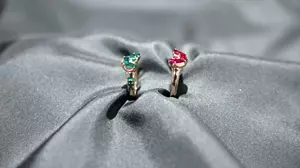 Only with the help of modern technology—such as detailed scanning, 3D printing, and reverse engineering—were scientists able to accurately document the ring’s features, create a digital version, and then produce faithful replicas using authentic materials like gold, emeralds, and rubies. Thanks to these advancements, experts could recreate the appearance of the pair of rings, which likely still adorns Peter Vok himself.
3. The biggest ring in Prague? Look up at the House of the Golden Ring
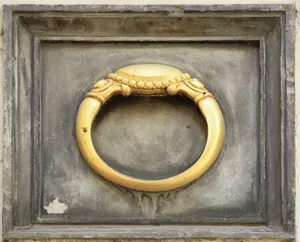 However, rings are not only found buried, in displays, or in folklore. One of Prague’s “gems” literally hangs just above you as you stroll through the Old Town. The House of the Golden Ring is named after the house’s sign—a grand gold ring above the entrance.
In times before house numbers, signs were crucial for navigation. A ring above a door could indicate a resident who was a goldsmith, jewelry merchant, or one interested in symbols of loyalty and honor. According to legend, one of the ghosts from the Old Town dropped the ring, and a local resident hung it above his door as a protective charm against evil spirits. Today, this building is home to an exhibition of the Museums of Prague, yet the magic of the old sign remains. Just look up, and you’ll find yourself enveloped in a captivating story where the ring became a landmark and the essence of the entire house.
4. The magical ring of the Rosenbergs: a protective charm against disease
 Another remarkable ring that draws curiosity is another one from the Rosenbergs. It has long been linked to Peter the Great but actually was never owned by the last of the Rosenbergs. Just like the famed Order of the Golden Fleece and the Cross of Zavis, it is preserved in a monastery in Vyšší Brod.
Upon closer examination, scientists discovered the ring is too small for Vok’s finger. It likely belonged to his brother William, who rests in one of the luxurious tin sarcophagi beneath the Church of St. Vitus in Český Krumlov. The ring’s band is engraved with a Latin passage from the Bible, but it’s more than just a decorative touch. In some medieval medical writings, you’ll see similar inscriptions as components of “recipes” for protective rings believed to shield the wearer from diseases, even the plague.
Modern-day visitors are captivated by the mystical Rosenberg ring, which appears almost otherworldly: delicate, expertly crafted, bearing an inscription that is both spiritual, magical, and practical. Gazing at it gives you a clear sense of why one might jokingly suggest it could very much inspire the One Ring from The Lord of the Rings.
5. Tolkien and the world’s most famous ring
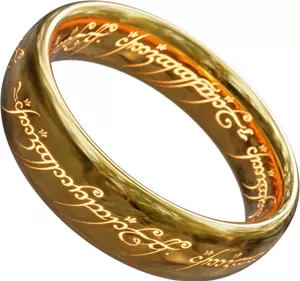 The One Ring from Lord of the Rings governs everyone might seem like pure fantasy, yet the notion of an all-powerful ring has existed in European culture long before Tolkien’s era. This concept appears in myths, operas, folk tales, and ancient chronicles. The recurring theme is that of a ring possessing extraordinary abilities but often leading to trouble.
Rings also feature in classic works of Czech literature. In Erben’s ballad The Wedding Shirt, a ring symbolizes the bond between living and deceased people; in various other tales, rings signify loyalty or sometimes expose betrayal. They carry with them secrets, mysteries, and unexpected turns.
When you relate the legend of the magical ring of the Rosenbergs to other stories in Europe, The Lord of the Rings starts to feel less like mere fiction. This doesn’t imply that the famous British author drew inspiration from a treasure from Highgarden, but it underscores how deeply ingrained the image of the “ring of fate” is in our collective psyche. Such symbolism holds a strong position in Czech history—from St. Wenceslas through the noble houses whose rings served not just as decorative items but as a clear indicator of their authority and protection.
6. The largest ring in the world: a ring adorned with 24,679 diamonds
Is it the most iconic ring from Lord of the Rings, Princess Diana’s wedding ring, or perhaps another? While we can’t say for sure, we do know which one holds the title for the biggest. The Indian jewelry brand SWA Diamonds has created a ring that truly redefines “ornate.” It’s named Ami, which means immortality in Sanskrit, and is embellished with an astounding 24,679 diamonds.
The ring features forty-one white gold petals, all painstakingly set with countless tiny, natural stones. This is no lightweight piece—it weighs about 340 grams. Months were spent developing the mold using 3D printing, casting the gold, setting the stones, and then confirming the authenticity and total count of diamonds, but the output earned an entry in the Guinness World Records.
Interestingly, even though it’s a record-breaking marvel, according to SWA Diamonds, its value is under a hundred thousand dollars. The record serves more to demonstrate what can be achieved in jewelry design rather than for economic significance, showcasing how far one can deviate from conventional rings.
7. The Pope’s rings: the world’s mightiest jewel that must be destroyed
 Following the story of rings leads us to bishops, popes, and other church officials. One of the most well-known symbols of authority globally is the papal signet ring, referred to as the Fisherman’s ring. It features the likeness of St. Peter, the fisherman whom Catholic tradition regards as the first pope, and has long been used to seal official documents.
That’s why after a Pope passes away, a tradition dictates that something must happen to this ring that would deeply upset jewelry aficionados: it must be destroyed or at least defaced. This was once done literally with a hammer, but nowadays, it’s either broken or a profound cross is etched across the seal. This act symbolizes the same intention as deactivating an account password or cancelling an electronic signature. The goal is to prevent the ring from being used for fraudulent documents after the Pope’s death.
Thus, the ring, once a symbol of supreme authority, transforms into a relic that should never again “speak” with an official voice. It powerfully reminds us that even the greatest authority is temporary—and in this case, the ring functions more as a tool than a piece of jewelry.
When viewed through a historical lens, rings reveal themselves to be a compact chronicle. They could represent the narrative of the ring that reminds us of our duty to govern justly. Think of the Rosenberg wedding rings, reunited after four centuries in the showcase of the monastery in Vyšší Brod, or the protective magic ring against disease, a house sign in the form of a ring nestled in the heart of Prague, or the Pope’s ring that, upon the death of its wearer, ceremonially vanishes from history. And also consider the modern extremes filled with diamonds and film sagas where one ring has the power to alter entire realms.
Whether you visit Vyšší Brod, stroll past the Golden Ring House in Prague, or simply admire the ring on your hand, you might ponder a simple truth: every ring comes with a story. Sometimes, it’s a legendary tale from history, other times it’s a cherished family memory. It’s possible that the next story being crafted may well be about the ring you will wear in the future.


