
Rückl’s Sun Baths

At the turn of the 20th century, Europe was turning back to nature. Doctors recommended spending time in the fresh air, sanatoriums were springing up in the mountains and by the sea, and the sun was becoming a symbol of a healthy life. Healing with sunlight, or heliotherapy, had been known to doctors since ancient Rome – and it was this old belief that Antonín Rückl built on with his sun baths.
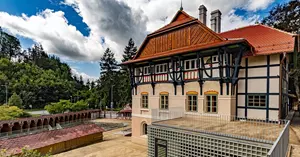 As early as 1903, the famous Sun Baths opened in Luhačovice, an open-air pool originally filled with water from the Šťávnice stream. Antonín Rückl went one step further. He believed that if the sun is the source of life, it must also be a healer – and that there was no need to travel to a spa when anyone could invite the sun into their own home, for example into the garden.
Glassmaker, Fisherman, and Idealist
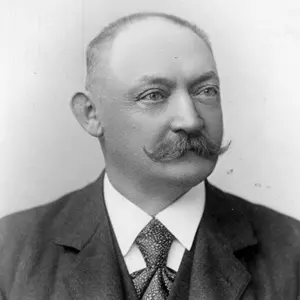 Antonín Rückl (1871-1938) came from a notable glassmaking family in Nové Mitrovice, located in the Pilsen region. He had a deep understanding of glass, including its chemistry and uses. After studying at a business academy in Prague, he refined his skills with his cousin Adolf Rückl in Kamenický Šenov. Yet his heart belonged to nature, and fishing became his great passion. At his trout farm in Nové Mitrovice, he invented the world-famous Simplex hatching apparatus. It was there, in the garden of his house, that he also built his first healing sun bath; the idea of treating the body with warm sunlight reportedly came to him after an injury from a fall from a horse. He had no idea that his glazed octagonal gazebo would start a trend with thousands of followers.
In 1921, Antonín Rückl moved to Řevnice, where he built another sun bath, half-timbered and more solid than the first. Visitors who came for a cure included the writer Ignát Herrmann, who mentioned the experience in his diary.
How Did Rückl’s Sun Baths Work?
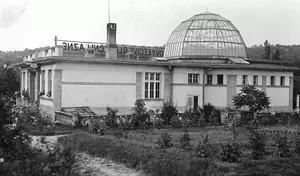 The principle was simple, yet bold for its time. Rückl designed a special glass that blocked ultraviolet radiation and let through only the “healing” rays that warmed the body and could help with various ailments.
Inside the glass domes, temperatures could rise as high as 60 °C. The body was thoroughly warmed without being put under stress. After sunbathing, patients moved to a cooler resting room. There they were wrapped in blankets and left to sweat, which, according to Rückl, was the crucial moment of the treatment. They could only drink warm liquids, ideally herbal tea.
After two or three visits, people grew fond of the baths; after ten sessions, many reported marked physical and psychological relief. Side effects were reportedly never proven, which only boosted the treatment’s popularity among the public.
Sun Baths as a Fashionable Trend
The initial gazebo offered little privacy, so when Rückl began selling licences to interested people across the country, more elaborate structures appeared: brick buildings with a steel frame and a distinctive glass dome.
In the 1920s and 1930s, dozens of Rückl sun baths were built – public ones, family ones and small domestic ones that could be placed on a roof or terrace. The sun baths became a fashionable symbol of the First Republic and often a striking architectural feature of villa districts and gardens. People came to them in search of health, rest and hope where conventional medicine often failed. Nor did they stay within the Czech lands: the most distant Rückl sun baths are in Juan-les-Pins near Antibes on the French Riviera, and there was interest from Portugal, Italy, Bulgaria, Yugoslavia and the USA.
Hodkovičky: The Most Famous Sun Baths
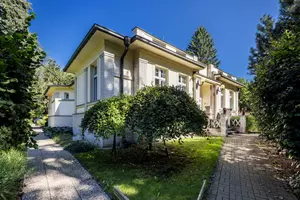 The best-known public Rückl Sun Baths were built in 1922–1923 in Prague, at Zátiší in today’s Hodkovičky, once a summer resort of Prague’s high society and later a villa district. They were open every year from April to September and successfully treated conditions such as tuberculosis, lung catarrh, and rickets.
Today, the building houses the Pronatal Sanatorium and Assisted Reproduction Centre, but observant viewers will recognise Rückl’s Sun Baths in the episode Turkish Earrings of the series Sinful People of Prague. Rückl referred to this large structure topped with a glass dome as his “great Temple of the Sun.”
The Unrecognised Visionary
Although Rückl’s Sun Baths were very popular with the public, their inventor met with indifference from the medical community and state institutions. As he was not a doctor, he was often viewed with distrust, even though his methods brought results.
Antonín Rückl, a passionate fisherman, businessman, inventor and idealist, died in September 1938 penniless, unrecognised and almost forgotten. His ideas, however, lived on.
What Remains Today?
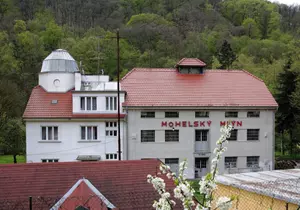 Rückl’s sun baths are an intriguing social and cultural phenomenon that remains largely unexplored. More than twenty buildings have been traced, although most of them have been demolished. Surviving examples can be seen in locations such as Bechyně, Černošice, near Mohelno, and Dolní Beřkovice close to Mělník. You can read more about the glass healing domes and their inventor’s remarkable life in the book Rückl’s Healing Sun Baths by Karel Tichý.
The sun continues to rise and set, solstices come and go, and the belief in the sun’s healing power returns in new forms. The story of Antonín Rückl is a reminder that sometimes it is enough to look towards the light – and not be afraid to go against the current.


