
7 things you may not know about the Winter Olympics, plus the 2026 Winter Olympics in Italy

2026 Winter Olympics in the Italian cities of Milan and Cortina d’Ampezzo
The XXV Winter Olympic Games will take place in the Italian cities of Milan and Cortina d’Ampezzo. The opening ceremony is scheduled for 6 February and the closing ceremony for 22 February 2026.
The Winter Olympics return to Europe
This will be the first time the Olympics have been held in Milan, twenty years after the Winter Games in Turin and seventy years after the 1956 Winter Games in Cortina d’Ampezzo. Milan will be the fourth Italian host of the Olympic Games. It will join Cortina d’Ampezzo (1956), Rome (1960) and Turin (2006). The Winter Olympics are returning to Europe after a long absence, as the 2018 Games were hosted by Pyeongchang, South Korea, and the 2022 Games were hosted by Beijing, China. In 2019, the Italian Milan–Cortina d’Ampezzo bid beat the Swedish Stockholm–Åre bid.

Records of the 2026 Olympics
The Olympics will go down in history for having the largest number of athletes (2,900) and 116 medal events, as well as the large distances between the main centres. Milan and Cortina are 350 kilometres apart, which means that athletes will not meet each other as they do at other Olympics. There will even be six Olympic villages.
Competitions, disciplines and new features of the 2026 Winter Olympics
The programme of the Games will be expanded to include new mixed competitions; for example, women lugers will compete in doubles and women ski jumpers will take part in the large hill competition. Ski mountaineers will also appear at the Olympics, in the sprint, which promises to be exciting, and in mixed relays. For the first time, freestyle skiers will also compete in parallel (dual) moguls.
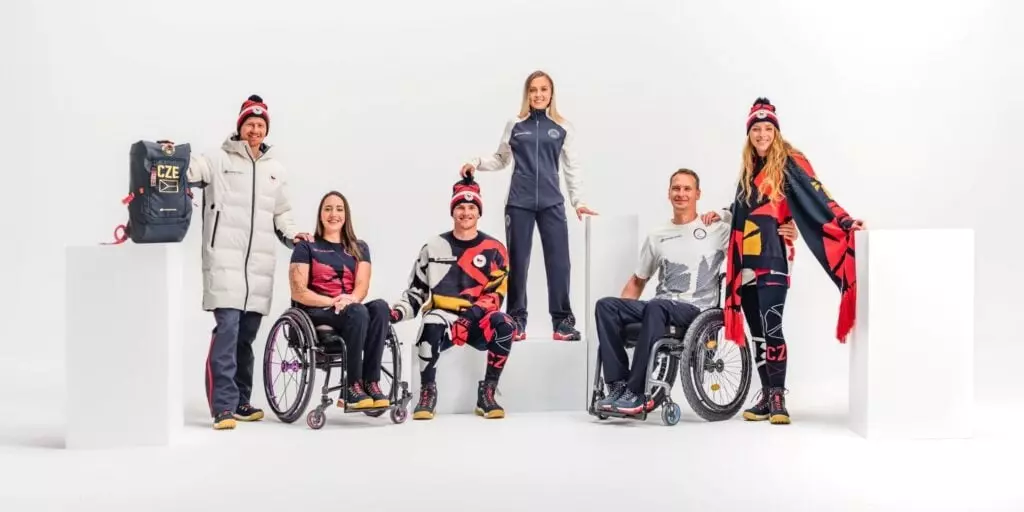
The Czech collection for the 2026 Winter Olympics will be inspired by Vojtěch Preissig and Italian fashion
The Czech collection for the 2026 Winter Olympics will combine five ornaments by the graphic artist, painter, illustrator and type designer Vojtěch Preissig. The main designer of the collection, inspired by the 1956 Winter Olympics in Cortina and Italian style, is Milan Jaroš. The entire collection has a 1950s feel – sweaters, shorts, scarves and graphic motifs reminiscent of old postcards from the Alps. The collection also includes the third version of the legendary Raškovka hat. The collection features gloves on a string, which evoke nostalgia and remind us of childhood, when gloves hung from the sleeves of overalls. Previous collections were inspired by the works of František Kupka, Alfons Mucha and Vladimír Boudník. This time, the ornaments come from Vojtěch Preissig.
Martina Sáblíková will say goodbye at the Games in Milan and Cortina
After a twelve-year hiatus, NHL hockey players will return to the Winter Olympics in February 2026. These Games will be Martina Sáblíková’s Olympic farewell and, hopefully, a successful Games for Ester Ledecká. The pre-Olympic season brought Czech athletes a total of six medals: Ledecká won gold in the snowboard giant slalom and bronze in the alpine skiing downhill, Sáblíková won silver in the 3,000 metres speed skating, and bronze medals were also won by skeleton racer Fernstädtová, speed skater Jílek in the 10,000 metres and the mixed biathlon relay team.
Olympic Festival in České Budějovice
The Games will be followed by a large Czech audience. For fans who cannot travel to Italy, the traditional Olympic Festival will take place, this time from 6 to 22 February 2026 at the exhibition centre in České Budějovice.
When will we see the Czechs in action?
Czech participation will probably begin with the women’s ice hockey team in a match against the USA. Their tournament begins on 5 February, the day before the opening ceremony. Martina Sáblíková, at her sixth Olympics, will race the long distances on 7 and 12 February, while the biathlon competitions will be spread throughout the Games from 7 to 21 February.
Where will the competitions take place?
The opening ceremony, a big draw for sports fans, will take place in Milan at the famous San Siro stadium. However, the Games will not be held only in Milan and Cortina d’Ampezzo. Biathletes will compete in Anterselva. Livigno will host freestyle skiing and snowboarding competitions. Bormio will become a temporary home for alpine skiers and ski mountaineers. Val di Fiemme will host cross-country skiing competitions.
Old and new sports venues
Most of the sports at the 2026 Winter Olympics will use existing venues or temporary structures that will not place a further burden on the landscape and will be removed after the Games. The only new venues are the Milano Santa Giulia ice hockey arena, which is to become the Eventim multi-purpose arena after the Games, and the bobsleigh, luge and skeleton complex in Cortina.
What medals will be contested at the Winter Olympics?
The medals will be made from recycled metal obtained from manufacturing waste and will be showpieces of Italian design. The bronze medals weigh 420 grams, while the gold and silver medals weigh 500 grams.
What about the Paralympic Games?
The Paralympic Games, which follow the Olympics, have not been forgotten. They are scheduled for 6 to 15 March 2026.
1. The first Olympics: Chamonix 1924
The Winter Sports Week held in Chamonix, France, in 1924 was a significant turning point. The decision to recognise the Winter Sports Week in Chamonix as the first Winter Olympic Games was made in Prague in May 1925 at the 8th Olympic Congress, and the proposal was submitted by Josef Rössler-Ořovský.
2. Olympic sports
 The first Winter Olympics in Chamonix featured competitions in eight winter sports: cross-country skiing, four-man bobsleigh, curling, figure skating, ice hockey, speed skating, Nordic combined and ski jumping. The programme also included a military patrol race, which later developed into biathlon.
Today’s programme includes fifteen sports: freestyle skiing, alpine skiing, cross-country skiing, biathlon, bobsleigh, curling, figure skating, ice hockey, speed skating, short track speed skating, luge, Nordic combined, skeleton, ski jumping and snowboarding.
3. Alternation of Winter and Summer Olympics
Until 1992, the Winter Games were held in the same year as the Summer Games, but then a change was made: the 17th Winter Olympics were held in Lillehammer, Norway, in 1994, and since then the Summer and Winter Olympics have alternated every two years.
4. Olympic mascots
 Today, mascots are part of every major sporting event, but they first appeared not so long ago. The first (unofficial) mascot was the character Schuss at the 1968 Winter Olympics in Grenoble, and the first official mascot was Waldi the dachshund for the Summer Olympics in Munich. The first official Winter Olympics mascot was the snowman at Innsbruck in 1976.
5. Ice hockey at the Winter Olympics
For Czechia and the former Czechoslovakia, ice hockey is the most successful sport at the Winter Olympics: counting one bronze from the Summer Olympics in Antwerp, the hockey players have won eight medals. Ski jumpers have brought home seven medals, and figure skaters and cross-country skiers five each. Apart from the famous victory at the 1998 Olympics in Nagano, Czech ice hockey has not shone as brightly in the era of the independent Czech Republic.
6. Czech successes at the Winter Olympics
 Czechoslovakia brought home a total of 25 medals from the Winter Olympics, while the independent Czech Republic has won 31 Olympic medals.
The most successful Czech Olympians are speed skater Martina Sáblíková and cross-country skier Kateřina Neumannová, both of whom have six medals to their credit. Biathlete Ondřej Moravec and cross-country skier Květa Jeriová-Pecková have won three medals each.
Snowboarder and skier Ester Ledecká, ski jumpers Jiří Raška and Pavel Ploc, snowboarder Eva Samková, and biathletes Gabriela Soukalová, Veronika Vítková, and Jaroslav Soukup have two medals each.
7. History of the Winter Olympics
Here are the individual Winter Olympics in order:
-
 1924 Winter Olympics in Chamonix, France: The Czechoslovak team consisted of 27 men. The best result was achieved by figure skater Josef Slíva, who finished fourth.
-
- 1928 Winter Olympics in St. Moritz, Switzerland: Czechoslovakia was represented by 24 men and one woman. The first Olympic medal for Czechoslovakia was won by ski jumper Rudolf Burkert, who finished third. Skeleton was a new event, and Norwegian figure skater Sonja Henie caused a sensation by winning the figure skating competition at the age of fifteen; her record as the youngest Olympic champion stood until 1998.
-
- 1932 Winter Olympics in Lake Placid, USA: Czechoslovakia’s smallest Olympic team had only six members – five skiers and one figure skater – as the other athletes decided not to travel overseas because of the high cost.
-
- 1936 Winter Olympics, Garmisch-Partenkirchen, Germany: Czechoslovakia sent a total of 55 athletes to the Games. Downhill skiing was included for the first time. The ice hockey team finished fourth and skier František Šimůnek took fifth place in the Nordic combined.
-
- No Olympic Games were held in 1940 and 1944 because of the Second World War.
-
- 1948 Winter Olympics, St. Moritz, Switzerland: The team had 47 members. The ice hockey team brought home a silver medal.
-
- 1952 Winter Olympics in Oslo, Norway: Czechoslovakia was represented by 22 athletes, but without success. The hockey players finished fourth.
-
- 1956 Winter Olympics, Cortina d’Ampezzo, Italy: The Czechoslovak team had 41 members. The figure skating competitions were held outdoors for the first time, and these were the first Games to be broadcast on television.
-
- 1960 Winter Olympics in Squaw Valley, USA: Czechoslovakia sent 22 athletes, and figure skater Karol Divín won a silver medal. The ceremonies were organised by Walt Disney, and biathlon and women’s speed skating competitions appeared in the programme for the first time. These are the only Games at which bobsleigh was not contested, as the Americans refused to build a bobsleigh track due to the low number of participants.
-
- 1964 Winter Olympics in Innsbruck, Austria: The team had 46 members. The Games were marked by a lack of snow, and the army had to bring in snow from the surrounding area. Luge competitions were held for the first time. The ice hockey team won bronze medals, while figure skater Karol Divín and ski jumper Josef Matouš finished just below the podium. Thirteen-year-old figure skater Ondrej Nepela participated in the Games for the first time.
-
- 1968 Winter Olympics in Grenoble, France: Czechoslovakia had 48 athletes at the Games. Doping controls were carried out for the first time. Jiří Raška won Czechoslovakia’s first ever gold medal in ski jumping on the medium hill, and added a silver medal in the large hill event. The ice hockey team also brought home silver, and figure skater Hana Mašková won bronze.
-
- 1972 Winter Olympics, Sapporo, Japan: The Czechoslovak team at the first ever Winter Olympics in Asia had 42 members. Ondrej Nepela won the country’s first gold medal in figure skating, while the ice hockey team and cross-country skier Helena Šikolová added bronze medals.
-
- 1976 Winter Olympics, Innsbruck, Austria: The Games were originally supposed to be held in Denver, USA, but the city withdrew for financial reasons. Innsbruck stepped in and hosted the Games again after twelve years. The Czechoslovak team had 57 members and won only one medal, silver in ice hockey. For the first time, a figure skating competition for dance couples was held.
-
- 1980 Winter Olympics, Lake Placid, USA: The Czechoslovak team had 41 athletes and won one medal, bronze for cross-country skier Květa Jeriová. The women’s cross-country relay team and dance couple Liliana Řeháková & Stanislav Drastich finished just below the podium. The star of the Games was American speed skater Eric Heiden, who won all five possible gold medals in speed skating.
- 1984 Winter Olympics in Sarajevo, Yugoslavia (Bosnia and Herzegovina): Czechoslovakia took part with fifty athletes in the first Games held in an Eastern Bloc country. These Games were its most successful to date, with a total of six medals. Two silver medals were won by the ice hockey team and the women’s cross-country relay team, while four bronze medals were added by ski jumper Pavel Ploc, downhill skier Olga Charvátová, cross-country skier Květa Jeriová and figure skater Jozef Sabovčík. Most of the Olympic venues were destroyed shortly after the Games during the war in the former Yugoslavia.
-
- 1988 Winter Olympics in Calgary, Canada: The Games were held for the first time over a period of sixteen days and the Czechoslovak Olympic team had 60 members. Speed skating competitions were held indoors for the first time, as were team competitions in ski jumping. Pavel Ploc won silver in the ski jumping competition on the medium hill, and Jiří Malec won bronze. The men’s cross-country relay team also took bronze.
-
- 1992 Winter Olympics in Albertville, France: These Winter Olympics were held in the same year as the Summer Olympics. It was also the last Czechoslovak team (75 athletes) before the country split. Three bronze medals were won by the ice hockey team, the ski jumping team and figure skater Petr Barna.
-
- 1994 Winter Olympics in Lillehammer, Norway: Thanks to the new alternation of the Summer and Winter Games, the Lillehammer Games took place just two years after Albertville. The independent Czech Republic sent 64 athletes to Norway, but did not win a single medal.
-
- 1998 Winter Olympics, Nagano, Japan: The total number of athletes exceeded two thousand for the first time. The Czech team had 63 members and brought home a full set of medals from Japan. The most valuable medals were won by the ice hockey players in the Tournament of the Century, with cross-country skier Kateřina Neumannová adding silver and bronze. Snowboarding appeared on the programme for the first time, and 15-year-old figure skater Tara Lipinski became the youngest Olympic champion in history.
-
- 2002 Winter Olympics in Salt Lake City, USA: The Czech team consisted of 77 athletes. The unexpected Olympic champion was aerials skier Aleš Valenta, who won gold with a unique triple somersault with five twists, and Kateřina Neumannová won two silver medals. Skeleton returned to the programme and women’s bobsleigh competitions were held for the first time.
-
- 2006 Winter Olympics in Turin, Italy: Czechia was represented by 83 athletes. Cross-country skier Kateřina Neumannová won gold and silver. Cross-country skier Lukáš Bauer also won silver, and the ice hockey team won bronze medals.
-
- 2010 Winter Olympics, Vancouver, Canada: The Czech team had 92 members and won a total of six medals, equalling their success in Sarajevo. Three of these were won by Martina Sáblíková, gold in the 3,000 m and 5,000 m and bronze in the 1,500 m. Lukáš Bauer and the cross-country skiing team (Martin Jakš, Lukáš Bauer, Jiří Magál and Martin Koukal) added another bronze in the relay race, and Šárka Záhrobská also took third place in the slalom.
-
- 2014 Winter Olympics in Sochi, Russia: The Czech team consisted of 88 athletes and brought home two gold, four silver and two bronze medals, the most in the history of the Winter Olympics. Two gold medals were won by snowboarder Eva Samková and speed skater Martina Sáblíková, who also won a silver medal. The other medals from Sochi were won by biathletes Ondřej Moravec, Gabriela Soukalová, Jaroslav Soukup and Veronika Vítková.
-
- 2018 Winter Olympics in Pyeongchang, South Korea: Ninety-three Czech athletes travelled to the Olympics, the largest delegation in the country’s independent history. They brought home seven medals. Ester Ledecká won two gold medals and became the first woman in history to win in two different sports: skiing and snowboarding. Silver medals were won by biathlete Michal Krčmář and speed skater Martina Sáblíková, while bronze medals were added by biathlete Veronika Vítková, snowboarder Eva Samková and speed skater Karolína Erbanová.
-
- 2022 Winter Olympics in Beijing, China: The Czech team consisted of a record 115 athletes, ranging from 15-year-old ski jumper Anežka Indráčková to 36-year-old ice hockey player Roman Červenka. Ester Ledecká defended her gold medal in the parallel giant slalom snowboarding event, while speed skater Martina Sáblíková won bronze in the 5,000 metres.


