
How Agnieszka Holland showcases Czech history, landscape and spirit

Agnieszka Holland (born 1948) makes films that work like mirrors – sometimes showing painful truths, sometimes creating beautiful illusions, but always approaching their subjects with empathy. Don’t expect traditional biographies or the glorification of national heroes from her. Holland focuses on individuals who quietly struggle with their surroundings – and with their inner demons.
Explore her filmography with the Kudy z nudy portal and the Czechia in Film programme. Her films also reflect the Czech soul, from her 2025 film about Franz Kafka to older works that show us where we come from – and perhaps where we are headed.
Franz (2025): Kafka as we (don’t) know him
 Agnieszka Holland’s 2025 film explores the life of one of Prague’s most famous natives, whose name is now associated with absurdity and inner conflict: Franz Kafka. Inspired by the life, work and imagination of a writer who was remarkably ahead of his time, this powerful story is no ordinary biography. Marek Epstein’s screenplay portrays Kafka as a mosaic, beginning with his birth in Prague and ending with his death in an Austrian sanatorium. Simply titled Franz, the film combines real events from Kafka’s life with his literary works, so that viewers sometimes cannot tell where biography ends and fiction begins. The resulting kaleidoscope of fragments, dreams, letters and stories looks exactly as Kafka himself might have wanted – like an artistic essay on identity, fear, relationships and writing as a means of escaping reality.
The film about this iconic writer offers an unexpected perspective. When most people imagine Franz Kafka, they see a thin, sad, frowning man in a black suit and hat. Costume designer Michaela Horáčková Hořejší has surprisingly overturned this familiar image. Over 150 costumes were tailor-made for the lead actor, closely based on historical records of the period. Instead of the usual black, she chose dark blue, the colour of the night sky, which Kafka wears for most of the film, saving black for the key moment when he meets himself.
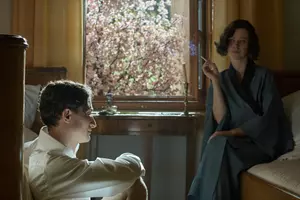 Filming took place in Prague, in the Old Town, the Lesser Town and at Prague Castle. The main character is played by the German actor Idan Weiss, while Kafka’s girlfriend and translator Milena Jesenská is played by Jenovéfa Boková. The cast also includes many Czech and German actors, such as Ivan Trojan, Vladimír Javorský, Karel Dobrý, Stanislav Majer, Juraj Loj, Jan Budař, Vasil Fridrich, Pavel Šimčík and Filip Kaňovský, with Josef Trojan in a triple role. Trojan also voiced the main character in the Czech version of the film. The film was released in Czech cinemas on 25 September 2025.
The film Franz and film awards
Franz was first screened at the 50th edition of the prestigious Toronto International Film Festival, the most important film festival in the Americas. At the 50th Polish Film Festival in Gdynia in September 2025, the film won several awards: the Silver Lion for Best Film, the Best Actor award for the German actor Idan Weiss for his portrayal of Franz Kafka, an award for the Polish cinematographer Tomasz Naumiuk for his outstanding camera work, and the make-up award for the Czech make-up artist Gabriela Poláková.
The makers of Franz also received three nominations for the European Film Awards, Europe’s equivalent of the Oscars, which confirms the film’s international recognition and artistic value. Idan Weiss was nominated in the Best Actor category, Gabriela Poláková for make-up and Michaela Horáčková Hořejší for costumes. In the end, however, the film did not win any of the awards.
Charlatan (2020): a healer between power and ethics
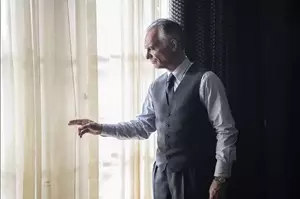 The story of Jan Mikolášek (1887–1973), who healed hundreds of people with herbs and diagnoses based on urine, is fascinating in itself. Holland, however, made it more than just a biography of an eccentric healing genius. Charlatan is a film about morality, faith and the price people pay for being different. In Agnieszka Holland’s interpretation, Mikolášek is a complex character: charismatic, reserved, sometimes harsh, but at other times entirely devoted to his talent and his weaknesses. The film also touches on suppressed homosexuality and personal isolation, but never descends into cheap psychologising. It is the story of a man who lived through two regimes – Nazi and Communist – and was able to help anyone who needed him. But at what cost?
Ivan Trojan excels in the lead role, with his son Josef playing him as a young man – an unusual casting decision that proved very successful. Most of the story was filmed in a former prison in Mladá Boleslav, and the film also features Hrabánek’s mill in the Šumava region and various locations in Prague.
 The film, based on a screenplay by Marek Epstein, had its world premiere in February 2020 at the Berlinale. Because of COVID-19 restrictions, it reached Czech cinemas considerably later, yet it attracted more than 252,000 viewers within two months. It was the first Czech film in history to be nominated for the “European Oscar”, the European Film Award for Best Director. The prestigious Telluride Film Festival included it in its programme, it won the Best Director award at the European Film Festival in the Serbian town of Palić, and it was shortlisted among fifteen films competing for an Oscar nomination in the foreign-language film category.
Of its fifteen nominations for the 2020 Czech Lion Awards, Charlatan won five: Best Film for the producers Kevan Van Thompson and Šárka Cimbalová, Best Director for Agnieszka Holland, Best Actor for Ivan Trojan, Best Cinematography for Martin Štrba and Best Sound for Radim Hladík Jr.
Burning Bush (Hořící keř, 2013): when the truth burns, the ashes of heroism remain
 In 2009, Agnieszka Holland and her daughter Kasia Adamik made the historical drama Jánošík – The True Story. A few years later, she returned to Czech themes. Burning Bush is probably the most powerful Czech television project of the last decade – and, paradoxically, it took a foreigner who understands Czech history to its core to make it. This three-part film, produced for HBO, returns to one of the key moments in modern Czech history: Jan Palach’s self-immolation in January 1969 and his mother’s subsequent legal battle for the truth against the lies of the normalisation regime. Impressive cinematography, powerful performances (Táňa Pauhofová, Petr Stach) and restrained direction create a work that often stirs strong emotions, yet avoids cheap pathos. Burning Bush has won a number of Czech Lion awards and international recognition, and it will rightly be remembered as a modern chronicle of a time when the truth really hurt.
The screenplay was written by the then-novice Štěpán Hulík, but Holland approached it as an intense thriller, exploring a reality in which truth must face propaganda and heroic deeds quickly turn into loneliness. Filming took place in authentic Prague locations – not only on Wenceslas Square, but also on the premises of the Faculty of Arts of Charles University, where Jan Palach studied. Agnieszka Holland herself studied at the Film and TV School in Prague (FAMU) during the Prague Spring and the early years of normalisation, graduating in 1971.
Over the Bones of the Dead (2017): when nature speaks the language of justice
The film mixes genres and styles, presenting an ecological detective story with elements of myth, fairy tale and cautionary tale. Based on Olga Tokarczuk’s novel (translated into Czech as Svůj vůz i pluh veď přes kosti mrtvých), Over the Bones of the Dead is set in the gloomy hills of the Czech–Polish border region, where people suddenly disappear – and suspicion falls on nature itself. The main character is Janina Duszejko, an elderly English teacher who loves animals and dislikes hunting. When strange things begin to happen around her, she has no choice but to take justice into her own hands.
The film has an enchanting visual atmosphere – fog, forests and crumbling roads create a space where reality blends with metaphor. Czech actors such as Miroslav Krobot appear in smaller roles, and the film’s mix of languages adds to its Central European character. Holland asks what is normal, what is fair, and who has the power to decide. Most of the filming took place in Poland, but the crew also spent several days on the Czech side, in the Broumov region, where the final scene of the film and the St Hubert’s Mass scene were shot.
Why Czechia? Why again and again?
 Although Agnieszka Holland is not a Czech director, she is in a way part of the Czech film and cultural world. She studied at FAMU, speaks fluent Czech, and for her Czechia is not only a place on the map but also a space for moral exploration. She is not interested in national pride, but in the specific stories of people – those who find themselves in situations where the right decision is a painful one. In films such as Burning Bush and Charlatan, she shows that Czech history is not just textbook material, but is full of emotions, doubts and courage that look nothing like a poster. Her view of Czechia is like a mirror that we may be afraid to look into. But once we take that step, we see not only shadows, but also light.
Holland’s other films share a similar ethos: a deep interest in people on the edge of history, of a regime or of their own identity. Her Oscar nominations were for Bitter Harvest (1985), Europa Europa (1990) and In Darkness (2012). The film Green Border (2023) received the Czech Lion Award for outstanding contribution to the audiovisual arts. Total Eclipse (1995), a dramatisation of the relationship between the poets Rimbaud and Verlaine, in which the young Rimbaud is played by Leonardo DiCaprio, also leaves a strong impression. A story from Poland as powerful as Burning Bush is told in the 1988 film To Kill a Priest, inspired by the murder of the Polish priest Jerzy Popiełuszko.


